





Eye For Film >> Movies >> Why Do I See You In Everything? (2026) Film Review


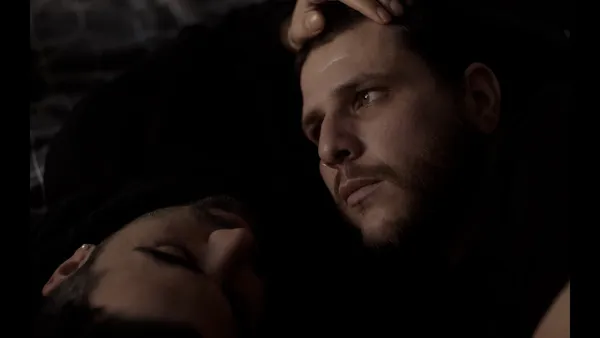

Why Do I See You in Everything? is a poet’s documentary, and not the sanitised kind of poetry the literary establishment gatekeepers tolerate today. It is the older kind, the kind that is willing to rhyme when rhyme is considered naïve. Not in couplets, but in kindred spirits. In shared breath. In a politics of tenderness that refuses to be embarrassed by care. Following two lifelong Syrian friends, Nabil Altawil and Qusay Awad, Rand Abou Fakher’s feature debut moves between an intimate day in Berlin and a decade-plus of resistance remembered through personal footage from the early years of the Syrian uprising, then back into the present where solidarity with Palestine is met with punishment that feels both familiar and chillingly normalised.
The opening frames set the grammar. A narration personifies an uprooted tree as images show olive trees hauled on trucks, like evidence and like spoil. The metaphor is blunt because the history has been blunt. Land is taken, replanted, burned, stolen, renamed. In Berlin, Nabil and Qusay lie on a bed and talk in the low register of people who have lived too long inside pressure. Their conversation is heavy but not performative. It is the kind of closeness patriarchal systems train men to avoid, and the documentary makes that avoidance feel like one more border. Nabil speaks with the fatal clarity of someone who has stopped believing that history changes without cost, as director Rand Abou Fakher points the camera toward their intimacy with claustrophobic clarity, keeping its tenderness present without insisting on labels.
In present-day Germany, exile doesn’t read as safety so much as a change of uniform. Qusay and Nabil carry the memory of protesting Assad as teenagers, a memory with a body-count and a price. Nabil was imprisoned at 16 for six months. Now in Berlin, as Gaza is devastated in real time and the killing of civilians is argued into background noise, they watch a self-described democracy crack down on peaceful demonstrations demanding Palestinian liberation and an end to the slaughter.
For them, Germany isn’t the opposite of dictatorship. It is the same reflex dressed in legality. That contradiction terrifies them, not as abstract politics but as déjà vu, and it explains the film’s most charged formal decision, the braiding of sound from the Berlin protests with images from the Syrian streets of the 2010s. Megaphones, sirens, shouted orders and crowd noise collapse time, and the same machinery speaks through different accents. Nabil’s narration turns Germany into an atmosphere of control. “There’s more police in this country than the air we breathe.” Abou Fakher does not claim Germany is Syria, but she insists that the logic of repression travels well, and that masculinity, disciplined into hardness by these systems, becomes another prison you’re expected to call normal.
If Why Do I See You in Everything? risks anything, it is legibility. Its leaps between cocoon, archive, protest, and return are emotionally lucid but not always narratively signposted, and some viewers may struggle to track what is happening, when, and where. At just 70 minutes, that density can feel compressed, the connective tissue more felt than explained. Yet the disorientation isn’t evasion. It is part of the refusal to become an explainer, and it doesn’t dilute its boldness so much as sharpen the sense that these lives are lived without clean transitions.
The title becomes literal in the way grief works. Everything starts to resemble everything else. After Nabil’s arrest at the Berlin protest, Qusay searches with his camera still running, caught inside a loop that’s framed as both political and bodily, a muscle-memory of fear. Later, after the fall of Assad’s regime reopens the possibility of return, Nabil goes back to Syria hoping to record rebirth. Instead, the camera encounters another collapse as their hometown area, As-Suwayda, is hit by fresh violence against the Druze community. The archive stops being memory and becomes obligation. The ethic is visible here. It is wary, careful, never neutral, and when violence becomes overwhelming it turns toward time, toward breathing, toward gestures of care rather than spectacle.
What persists, quietly and stubbornly, is the bond between these two men, undoing the hardness history demands they carry. In the final movement, the documentary offers a small vision of freedom that is not rhetorical. The two friends find themselves among olive trees again, and the act of choosing shade on one’s own land, without permission, reads as a human right that has to be relearned. The peaceful images dissolve into something dreamlike, but the dream is not escapism. It is resistance.
It is difficult not to suspect this work will be received with less generosity than other recent war/resistance documentaries that arrived with Europe’s sympathy already pre-approved. Some stories are granted instant moral legibility. Others have to argue for their own humanity while being policed, doubted, or treated as too political to mourn.
Reviewed on: 02 Feb 2026


